
- Steps to reduce pharma influence over Canadian docs criticized (statnews.com)
In effort to provide greater transparency in the relationships between physicians and the pharmaceutical industry has taken a controversial turn in Canada, where a leading medical society is being criticized for a new report on the topic...The College of Family Physicians of Canada, which represents more than 35,000 doctors, earlier this month released a report featuring 21 recommendations that address conflicts of interest and continuing medical education, among other things...The report emerges amid ongoing debate over the extent to which companies unduly influence medical research and practice. The CFPC, which itself does not accept industry funding, portrayed its effort as a forward-looking statement that will evolve in order to bolster trust and transparency among patients.
- Feds tell judge Martin Shkreli can go to Washington to testify before Congress (statnews.com)
Martin Shkreli appears to be a big step closer to testifying before a congressional committee...US Department of Justice wrote a letter Sunday to a federal judge overseeing a securities fraud case against Shkreli to say “the government does not object to (Shkreli) traveling to Washington, D.C., to comply with the House Committee’s subpoena” to testify at a hearing on prescription drug pricing. As part of his $5 million bail order, Shkreli is prevented from traveling outside parts of New York City and nearby Long Island...The letter paves the way for Shkreli to appear before the House Oversight and Government Reform Committee, which wants to explore the rising cost of medicines. A hearing had been scheduled for Tuesday, but it has been postponed to Feb. 4 due to the recent blizzard.
- China ingredient maker’s plant found in ‘devastated state’ by authorities (fiercepharmamanufacturing.com)

China, which manufactures most of the ingredients for Western products, has a reputation for having some pretty questionable manufacturing operations. Czech inspectors got a firsthand look at one plant that they said posed "extreme risks" to consumers...According to two reports on the plant posted by the European Medicines Agency, authorities dropped by the Huanggang City facility of Hubei Hongyuan Pharmaceutical in October after the plant had been mentioned as an intermediate manufacturing site for the antibiotic metronidazole. The company acknowledged in its introduction that the site didn't follow EU GMP standards, the report says. During a walk-through, inspectors confirmed that...They said they found a plant in a devastated state, with "huge layers of dust and product" that indicated that neither the plant nor the equipment was being cleaned or that equipment was being maintained. It was noted the situation posed "an extreme risk of cross-contamination." Additionally, almost none of the products that they saw had been labeled and there was no batch manufacturing documentation...Western authorities have stepped up inspections of Chinese plants, both of those owned by Chinese companies and those owned by Western drugmakers, and found problems in both cases.
- U.K. competition watchdog targets pharma for ‘substantial fines’ (fiercepharma.com)
Look out, pharma: Britain's competition watchdog is coming for you....The U.K.'s Competition and Markets Authority is planning to levy "substantial fines" this year, marking a "big step up in the scale and impact" of its enforcement activity, Alex Chisholm, head of the agency, told the Financial Times. And one of those fines will likely be directed at a pharma company...The CMA has been probing drugmakers including GlaxoSmithKline and Pfizer for alleged wrongdoing. "In high-value markets with big players, they should face big fines,"...For Pfizer, though, a resolution could still be a ways off. In August, the CMA accused the drugmaker and partner Flynn Pharma of running afoul of U.K. and European laws by jacking up costs for their epilepsy drug...The pair charged "excessive and unfair prices"...the CMA said at the time, raising costs by as much as 2,600%. Regulators plan to hand down a decision in the case in about three months..."While businesses are generally free to set prices as they see fit, those that hold a dominant position have a special responsibility to ensure that their conduct does not impair genuine competition and that their prices are not excessive and unfair,"...
- Biosimilar drugs get boost as UK cost agency backs their use (reuters.com)

Cheaper "biosimilar" copies of expensive biotech drugs received a boost in Britain...when the country's health cost-effectiveness agency NICE (National Institute for Health and Care Excellence) said patients needing such medicines "should be started with the least expensive drug"...So-called biosimilars are gaining ground in Europe, which has been faster to adopt their use than the United States, offering savings to healthcare systems and threatening sales of companies making original products...The latest ruling by the National Institute for Health and Care Excellence is a further victory for the biosimilar lobby and may help two cheaper copies win market share from five other original brands...The potential for biosimilars to win business from pricey original brands is not only a focus for healthcare providers but also a growing concern for investors, worried about the impact on large drug company earnings...A growing number of biosimilar versions of top-selling biotech medicines are set to reach the market in the next few years, although the scale of their impact is unclear...
- Novo aims to be ahead of pharma pack with Iran investment (tehrantimes.com)
Novo Nordisk, the world’s top insulin supplier, expects to be ahead of the pack now nuclear sanctions are lifted in Iran, thanks to a continuous presence and a pre-emptive investment plan...(Iran) is an attractive target for Big Pharma seeking to sell new medicines to its large and growing population, but going in at ground level and securing good relations with authorities will be key, industry executives say...Medicines were an exception in the nuclear sanctions imposed on Iran, thanks to exemptions for essential drugs and other humanitarian goods. Yet shipping drugs into the country was far from trouble-free, due to tight curbs on financial transactions and restrictions on technology reaching the Islamic republic...“With the sanctions being lifted, we can operate more freely,” Jakob Riis, Novo’s head of marketing told Reuters at the World Economic Forum in Davos, Switzerland...The Danish company has maintained a staff of around 130 in Iran through the sanctions era and it now plans to more than double that, adding 160 additional staff, following a decision in September to invest 70 million euros ($76 million) on a factory...
- Medical publishers eye new ad viewability rules (mmm-online.com)
The Association of Medical Media plans to hold a meeting to establish an industrywide viewability standard...A group of medical publishers will attempt to develop a new industry standard for digital advertising viewability, a much debated topic that has vexed the broader advertising industry...Viewability—how long is long enough for a user to have viewed a digital ad successfully—has cropped up in recent years as one of the more challenging media issues, and one that needs to be addressed as the business of digital advertising matures. In healthcare, experts say, it's no different..."There's more pressure to account for dollars,"...The group's perspective is that professional medical content differs from other online advertisers..."It is distinguished from general web content in many ways, including in its scarcity and its value to the end reader...industry experts have been saying that drugmakers will likely put more emphasis on digital advertising as brand marketing becomes more targeted to certain patient populations and manufacturers lose direct access to physicians and other prescribers. That could expose more advertisers to the vagueness of viewability and highlight the need to find a solution that makes sense given the nuances of medical advertising, notably content aimed at healthcare providers.
- The biggest implications of ICJME’s new clinical trial data sharing proposal (biopharmadive.com)Sharing Clinical Trial Data — A Proposal from the International Committee of Medical Journal Editors (nejm.org)Chasing transparency in the pharmaceutical industry: How much is enough? (biopharmadive.com)

Editors, who wrote an editorial discussing the issue in last week’s New England Journal of Medicine, “many funders around the world—foundations, government agencies, and industry—now mandate data sharing. “...Things have evolved a great deal since November 2014, when the National Institutes of Health proposed forcing pharma companies to put all data from clinical trials—successful and otherwise—online. This so-called “transparency initiative” was supported by more than 80,000 individuals and 500 organizations with a vested interest in clinical trial data transparency. Even earlier, in 2007, a U.S. law came into effect making failure to register clinical trials illegal.
- Fast-forward to January 2016
- ICJME: “Data-sharing guidelines are needed”
- The power of individual de-identified patient data
- No data-sharing plan, no publication
- Concerns about research parasites
- Dialing back the paranoia
- 2015: A banner year for personalized medicine (catalyst.phrma.org)
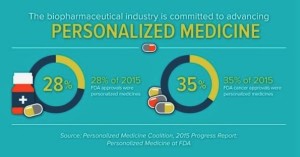
2015 was a record year for personalized medicine approvals, according to a new analysis from the Personalized Medicine Coalition. This news confirms the growing role of personalized medicine as an approach to treatment that can improve outcomes for patients and also create important efficiencies in the health care system. Personalized medicine is an emerging field of medicine that uses diagnostic tools to identify specific biological markers to help assess which medical treatments and procedures will be best for each patient. Personalized medicine also takes into account patients’ medical history, circumstances and values in developing targeted treatment and prevention plans...45 novel new drugs approved in 2015, the new analysis indicates that 28 percent of novel new drugs approved by the Food and Drug Administration...were personalized, or precision, medicines...Some of the personalized medicine highlights from 2015 include:
- Two new medicines for patients with different forms of non-small cell lung cancer;
- A new combination therapy for patients with cystic fibrosis;
- Two new medicines to help patients with a difficult-to-treat form of high cholesterol; and
- A new targeted therapy for melanoma.
- Levaquin users slap J&J with $800M RICO suit, claiming pharma giant hid serious side effects (fiercepharma.com)
Johnson & Johnson is facing yet another lawsuit over its antibiotic Levaquin from people who claim that the company hid serious side effects. The latest legal action comes a couple of months after an FDA panel flagged serious problems associated with the entire class of antibiotics and voted to change the meds' labels...Five plaintiffs allege in a new suit that J&J and its Janssen unit deliberately mislabeled and misbranded Levaquin (levofloxacin), playing down harmful side effects for its own financial gain. The plaintiffs sued J&J and others--including former FDA commissioner Margaret Hamburg--under the federal Racketeer Influenced and Corrupt Organizations act, a law typically used to prosecute organized crime. "These concerted efforts resulted in significant harm and/or death to consumers of Levaquin, including plaintiffs," according to the suit...The plaintiffs are seeking more than $120 million in compensatory damages and more than $750 million in punitive damages to drive home "the seriousness of their egregious conduct and to deter similar conduct in the future."...The latest suit marks another chapter in J&J's Levaquin saga. The company has encountered thousands of lawsuits over the past several years from plaintiffs claiming that it did not adequately warn patients about the drug's dangers.