
- Indiana bill encourages sale of meth-resistant PSE products (drugstorenews.com)
Community Pharmacies of Indiana...announced the organization's unanimous decision to support Senate Bill 80, also known as the Pharmacist Legitimization Bill...as a method to control the sale of pseudoephedrine products and decrease meth manufacturing in Indiana without requiring a prescription and unfairly penalizing law-abiding customers...Under the bill, cold medicines containing single-ingredient PSE, such as Sudafed, will remain available for behind-the-counter sales without a prescription. The bill would enable pharmacists to briefly consult with customers seeking products containing single-ingredient PSE, inquiring about symptoms and potentially recommending effective, non-prescription PSE products that contain meth-resistant safeguards, such as Nexafed and Zephrex-D…The bill would also grant pharmacists the legal protection to decline potentially illegitimate sales of PSE products that lack meth-resistant features where appropriate...Pharmacist Legitimization Bill represents common-sense legislation that balances efforts to help curtail the proliferation of meth labs throughout our state while also preserving the customer's ease-of-access to effective cold medicines for legitimate use without the burden of obtaining a prescription every time they have a head-cold…
- China continues to fine-tune drug, food safety procedures (fiercepharmaasia.com)
The government of China continues to refine its legal powers to deal with drug safety issues, according to a release from the country's Supreme Court that says investigations will be streamlined to identify administrative cases that potentially involve major criminal breaches...The new measures are designed to "facilitate coordination between administrative and judicial organs in handling food and drug safety cases," according to a report from the Shanghai Daily...The China Food and Drug Administration and the Ministry of Public Security, the Supreme People's Court, the Supreme People's Procuratorate and the executive office of the food safety commission under the State Council, China's cabinet, said the measures will "streamline" standards and procedures and will include the possibility of suspected drug cases being transferred from administrative bodies such as the CFDA to police...These latest moves are an attempt by Chinese officials to bring trust to the "Made in China" label because most Chinese prefer foreign-made drugs which they believe are higher quality. Several Chinese and Indian companies in recent months have been slammed by regulatory authorities in the United States and Europe over lapses in good manufacturing practices and outright fraud in many cases where test results were falsified.
- Optimizing Relationships Among Manufacturers and Providers (specialtypharmacytimes.com)
David D'Altorio, PharmD, senior vice president of health services at MedImpact Healthcare Systems, discusses methods to improve communication among drug manufacturers and health care providers.
- American Emergency Rooms Are Facing Critical Drug Shortages (psmag.com)Longitudinal Trends in U.S. Drug Shortages for Medications Used in Emergency Departments (2001–2014) (onlinelibrary.wiley.com)
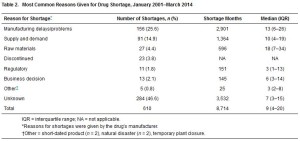
The shortfalls reveal deep problems in the market forces that control drug supply and demand...Over the past 14 years, American emergency rooms have faced more than 600 drug shortages, according to an analysis published last week in Academic Emergency Medicine. Among those shortages were lacks of life-saving, one-of-a-kind drugs such as naloxone...it's not just emergency rooms, though emergency medicine might be especially affected because production of injectable drugs is the most likely to come up short...the...analysis found that more than half of the missing emergency meds were for acute or life-threatening conditions. In most cases, doctors could substitute another drug for the missing one, but they were unable to do so five percent of the time...Why do these shortages occur? In the database the emergency-room researchers analyzed, the most commonly cited reason was a drug-plant shutdown due to quality control problems. But there are likely deeper causes. Those who buy injectable drugs for hospitals tend to choose the cheapest generics, without paying attention to quality...Another theory: The way hospital drugs are purchased encourages only a few companies to make generics, so when one company's factories go down, there's no one around to make up for the shortfall.
- Docket Alarm Launches Suite of Tools for Orange Book Litigators (prweb.com)Orange Book (fda.gov)

Docket Alarm’s new suite of tools has components that help give Orange Book litigators a competitive edge…the first legal research platform to provide Orange Book litigators a suite of tools for their practice. The features include the ability to track changes to the Orange Book and related litigation, search correspondence between drug companies and the FDA, and analytics on Orange Book cases in the Patent Trial and Appeal Board…The "Orange Book,"…is the authoritative resource on FDA approved drugs for patent litigators. When a drug company wins FDA approval for a new drug, they submit an Orange Book listing detailing applicable patents covering the new drug and the drug’s labeling. Generic drug manufacturers engage in patent litigation with the branded company over whether the patents listed in the Orange Book are valid and properly cover the corresponding drug.
- FDA slams another Indian drug maker for serious quality problems (statnews.com)
If there is a surefire way to arouse the concerns of Food and Drug Administration inspectors, try this: take a notebook listing manufacturing problems, place it in plastic bags along with other paperwork, and toss them in a nearby scrap yard where the inspectors can find them...Here’s another approach: leave “unofficial notebooks,” which are used to track manufacturing activities, lying around an office so the inspectors can read how bacteria is present in the water system, but become puzzled when the problem is not cited in official company records...These were just two of several “serious breaches” of good manufacturing practices the FDA cited in a Dec. 23, 2015, warning letter sent to Cadila Healthcare...What else concerned the FDA?
- There were problems with the potency of warfarin made at one plant and Cadila agreed to temporarily suspend production.
- ...nine consumer complaints were lodged by way of pharmacies and distributors over potential product mix-ups.
- Several batches of active pharmaceutical ingredients failed an analysis, but Cadila never explored why this occurred.
- 5 Drugs That Actually Decreased in Price Last Year (pharmacytimes.com)
Not every drug saw a price increase in 2015, despite widespread media coverage suggesting otherwise... Much of the national drug pricing debate last year centered on steep cost increases, including Daraprim’s infamous 5000% overnight price hike under former Turing Pharmaceuticals CEO Martin Shkreli... But the year wasn’t all bad news for Americans filling prescriptions...An analysis from the prescription drug cost comparison site GoodRx reveals that the 30 of the 50 most common generic drugs actually decreased in price by the end of 2015...Here are 5 popular generics that actually dropped in price last year:
- Fluoxetine (Prozac): decrease 30.4%, costs an average of $5 for a 30-day supply.
- Montelukast (Singulair): decrease 19.9%, costs an average of $18 for a 30-day supply.
- Duloxetine (Cymbalta): decrease 10.4%, costs an average of $38 for a 30-day supply.
- Atorvastatin (Lipitor): decrease 8.2%, costs an average of $13 for a 30-day supply.
- Losartan (Cozaar): decrease 4.8%, costs an average of $9 for a 30-day supply.
- FDA sues to stop a wayward drug compounder (statnews.com)
After nearly three years of sparring with a recalcitrant compounder, the Food and Drug Administration has filed a lawsuit asking a federal court to prevent Downing Labs from continuing operations. And the compounder agreed to a consent decree, which requires the company to take various steps before operations can resume...In the lawsuit, the agency cited numerous violations of so-called good manufacturing practices and several issued warnings to the company...about its failure to comply with regulations. Most recently, the Dallas-based compounder, which in 2014 refused to an FDA request to recall some products, failed yet another FDA inspection...the FDA inspectors found unsanitary conditions, according to the lawsuit...tests...found traces of...bacteria which, “if introduced into the body, can cause septic shock, pneumonia, and urinary tract infections,” the lawsuit stated...the Drug Quality and Security Act was passed to, in part, bolster compounding oversight. In fact, the FDA cited the defiant posture taken by Downing as an example of why a new law was needed to allow the agency to bolster its oversight and pursue legal options when compounders refused to upgrade operations.
- Activists sue Ohio to get drug pricing measure on the ballot (statnews.com)"Ohio Drug Price Relief Act" Summary Petition (sos.state.oh.us)
In the latest skirmish over prescription drug pricing, consumer activists filed a lawsuit against Ohio officials for ordering a review of signatures collected for a ballot measure designed to lower the cost of medicines...The proposed measure, known as the Ohio Drug Price Relief Act, would require the state to pay no more for medicines than the Department of Veterans Affairs. Currently, the VA gets a 24 percent discount off average manufacturer prices. A similar measure recently qualified for the ballot in California, despite opposition from the pharmaceutical industry...The lawsuit was filed two days after Ohio Secretary of State John Husted demanded election officials conduct another review of more than 171,000 signatures. He took that step after attorneys for the Pharmaceutical Research & Manufacturers of America, the industry trade group, wrote a letter to Husted to question the validity of many of the signatures that had been submitted...Drug makers are not taking any chances. In California, for instance, a spokeswoman for the industry campaign to defeat the ballot initiative recently called the proposal “misleading and flawed.”...She also argued the measure will increase the prices of prescription drugs sold to veterans and many California consumers, and reduce choices of medicines available. At the same time, she maintained the measure will cost taxpayers “millions more in state bureaucracy and lawsuits because it will be virtually impossible to implement.”
- Promise Of High Prices Now Driving Biopharma R&D Investments (forbes.com)
Once again, the biopharmaceutical industry had another banner year in 2015...in comparing the approvals of 1996 to 2015, a lot has changed over the years...the vast majority of drugs approved in 1996 were small molecule drugs...The drug approvals for 1996 are a reflection of the corporate strategy and the research philosophy embraced by Big Pharma at the time: find drugs that would be utilized by physicians to treat millions of patients suffering from common ailments...The “blockbuster” business model back then focused on having moderately priced drugs broadly prescribed...Companies have not totally abandoned this approach. Last year saw the approval of drugs expected to be billion dollar blockbusters by virtue of treating big populations of patients...What is stunning, however, is to see the number of drugs approved for small or “niche” populations, where high revenues are expected to be generated not by patient numbers but by price. Nowhere is this more evident than in the 14 new cancer drugs...I suspect that, for those who suffer from rare diseases or from certain forms of cancer, this shift in biopharma’s R&D priorities has been welcomed. As shown by the 2015 drug approvals, the promise of favorable pricing did stimulate innovation and improved the health of many. It will be interesting to see if political pressures, particularly in an election year in the U.S., impact this going forward.