
- Martin Shkreli just reminded us why we need Martin Shkreli (vox.com)Martin Shkreli, the Bad Boy of Pharmaceuticals, Hits Back (nytimes.com)

Martin Shkreli, CEO ,Turing Pharmaceuticals
Martin Shkreli thinks he made a mistake: He didn't hike the price of his drug enough…And that willingness to say something so awful, so off-putting, is just one reason why he's so darn useful to have around…Shkreli styles himself as a truth teller, saying the hard things that no one else is brave enough to reveal about health care. And in some ways, he's right! Major insurers, drugmakers, and hospital systems collect billions of dollars in annual earnings…but cloak many profit-driven decisions by defending them as beneficial for patients. By being brutally honest about his motives, Shkreli is a rare exception. His comments may be odious, but they're not baseless…That doesn't make them morally right, though. One reason we need Martin Shkreli is to protect against other Martin Shkrelis, who find ways to exploit the system and turn patients into profit centers.
- State, Local Officials Push Manufacturers to Pay for Drug Disposal (realclearhealth.com)

...drug disposal is expensive — the Nebraska program spends $10 per pound to ship and destroy medication — and some states and municipalities want drug companies to pick up the tab…Six municipalities in California require drugmakers to pay for take-backs. Nine states...have considered similar measures...Proponents say these laws, which are similar to programs that require manufacturers to pay for electronics recycling, would make it easier for patients to dispose of prescriptions. But drugmakers oppose the local mandates and warn that disposal costs could be passed on to patients through higher drug prices…Alameda County in California was the first jurisdiction to pass a law requiring manufacturers to pay for take-backs, in 2012, though the industry was quick to file suit, arguing it violated the interstate commerce clause of the U.S. Constitution. The Alameda law was upheld this year when the Supreme Court refused to hear the industry’s appeal…Drugmakers would rather lead their own take-back programs than comply with local or state mandates, said Priscilla VanderVeer, of the Pharmaceutical Research and Manufacturers of America...Because drugmakers sell across the country, meeting the customized disposal requirements of local programs is complicated...There are also more effective ways to get rid of the medicines, she said, like at-home disposal or returning unwanted drugs using special envelopes with carbon lining…“That’s just a financial and logistical nightmare for something that’s not necessarily going to be effective, or secure or environmentally helpful,” she said.
- DOJ antitrust unit subpoenas Mylan over pricing of doxycycline (reuters.com)

The antitrust division of the U.S. Department of Justice has subpoenaed Mylan N.V. for information relating to the marketing, pricing and sale of its generic doxycycline antibiotic products…Department of Justice has sought information on any communication with competitors about the anti-bacterial products, the company said in a regulatory filing, adding it would cooperate with the federal agency…drugmakers have been under increased pressure this year from the government, insurers and corporations over steep increases in the prices of generic drugs, which have dragged on shares in the sector… There are many forms of doxycyline made by more than a dozen companies, including Valeant Pharmaceuticals International, Allergan, and Hikma Pharmaceuticals, according to the U.S. Food & Drug Administration's database.
- How Big Pharma Could Lose the War on Disease (bloombergview.com)
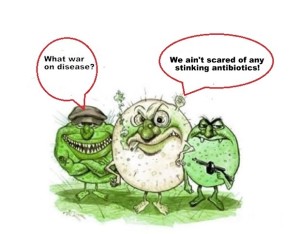
The planned merger of pharmaceutical giant Pfizer with competitor Allergan, aimed in large part at cutting the combined company's tax bill, illustrates a troubling trend in the industry: Firms are focused more on pursuing near-term profits than on the difficult, longer-term research needed to develop truly groundbreaking new drugs. This is unfortunate, because disease may be making a comeback…the accelerating spread of multi-drug-resistant bacterial infections. There are now more than two million cases each year in the U.S. alone. Last month, scientists announced that they had found evidence, in farm animals in China, that genes for antibiotic resistance are being transferred directly among different bacteria -- a trick (horizontal gene transfer) that will allow the resistance to spread more quickly than ever before…The pharmaceutical industry's reshaping doesn’t bode well for humanity's ability to respond. Almost all antibiotics in use today were discovered between 1940 and 1960. Research progress since then has been almost nil.
- Could Big Pharma Deals Cost the U.S. Jobs? (bloomberg.com)
Stanford University Hoover Institution's Tim Kane, Princeton Economics Professor Alan Krueger and Bloomberg Intelligence's Asthika Goonewardene discuss pharmaceutical company deals and the possible impact on U.S. jobs.
- National Health Spending In 2014: Faster Growth Driven By Coverage Expansion And Prescription Drug Spending (content.healthaffairs.org)
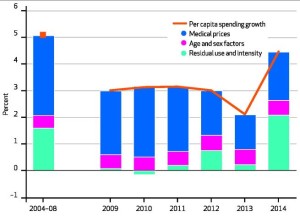
Factors Accounting For Growth In Per Capita National Health Expenditures, Selected Calendar Years 2004–14
US health care spending increased 5.3 percent to $3.0 trillion in 2014. On a per capita basis, health spending was $9,523 in 2014, an increase of 4.5 percent from 2013. The share of gross domestic product devoted to health care spending was 17.5 percent, up from 17.3 percent in 2013. The faster growth in 2014 that followed five consecutive years of historically low growth was primarily due to the major coverage expansions under the Affordable Care Act, particularly for Medicaid and private health insurance, which contributed to an increase in the insured share of the population…growth in total retail prescription drug expenditures accelerated sharply, increasing 12.2 percent to $297.7 billion…The strong growth in prescription drug expenditures in 2014 was caused by increased spending on new medicines, a smaller impact from patent expirations than in previous years, and price increases for brand-name drugs. The single largest driver of growth in specialty drug spending in 2014 was the impact of new treatments for hepatitis C, which contributed $11.3 billion in new spending.
The Affordable Care Act | Factors Accounting For Growth | Revisions To The National Health Expenditure Accounts | Sponsors Of Health Care | Private Health Insurance | Medicaid | Medicare | Out-Of-Pocket Spending | Retail Prescription Drugs | Hospital Care | Physician And Clinical Services
- Direct-to-consumer advertising makes doctors and patients stronger partners (catalyst.phrma.org)
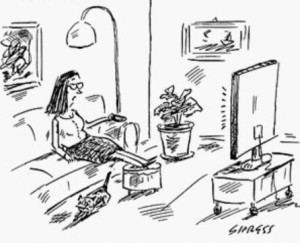
"Ask your doctor if talking a pill to solve all your problems is right for you."
The New York Times’ editorial board is right when it notes that direct-to-consumer pharmaceutical advertising helps “educate and inform patients about drugs their doctors might not mention, encourage discussions between doctors and patients, and can help patients take more responsibility for their own health care.”.. DTC advertising is designed to provide scientifically-accurate information to patients so that they are better informed about their health care and treatment options – and there is never any requirement or obligation for physicians to prescribe a particular medication…Beyond increasing patient awareness of disease (including undiagnosed conditions) and available treatments, DTC advertising has been found to increase awareness of the benefits and risks of new medicines and encourage appropriate use of medicines. In addition, such advertising encourages patients to visit their doctors’ offices for important doctor-patient conversations about health that might otherwise not take place.
- Three types of marijuana to hit Uruguayan pharmacies in 2016 (reuters.com)
Uruguayan National Drug Board (JND)
Uruguayans will be able to choose from three varieties of state-sanctioned cannabis when marijuana starts being sold in pharmacies in the small South American country next year…Each variety will have different levels of...tetrahydrocannabinol and cannabidiol..."There will be three options with indications about the effects of each that point beginners toward starting with the lowest level" of THC...Uruguay became the first country to legalize the cultivation and distribution of marijuana in late 2013, aiming to wrest control of the trade from gangs while regulating and taxing its consumption…Authorities have developed traceable, genetically-distinct plants to ensure they do not leave Uruguay's borders or end up on the black market…The government estimates registered marijuana users will be able to buy the drug from pharmacies in mid-2016, when the country's two licensed producers start selling their first commercial load of about four tonnes…Authorities are also working with companies interested in exploring the possibility of exporting medical marijuana to the United States and Europe...
- Publix enhances free medication program (chaindrugreview.com)
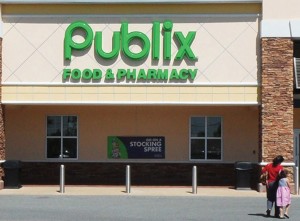
Publix Super Markets Inc. has expanded supply options in its free medication program to help patients on maintenance medicines…The food and drug retailer said...that Publix Pharmacy will now offer free 90-day supplies of metformin, lisinopril and amlodipine to customers with a prescription for the medications. Previously, 30-day supplies of these medications were offered under the retailer’s free medication program… Publix noted that it enhanced the program to promote its pharmacy patients’ medication adherence…“Publix Pharmacy continues to enhance our free medication programs to best serve the needs of our customers,”… “With health care and prescription costs continuing to rise, medication adherence may prove challenging. The enhancement to our free prescription programs and pharmacy services allows our customers to focus on staying healthy and achieving their overall wellness goals.”
- Eli Lilly’s Swiss lab closure worries animal rights group (reuters.com)
Eli Lilly's plan to close a Swiss laboratory that conducts tests and experiments on live animals has caused concerns by a local animal welfare group over the fate of the facility's hundreds of dogs, cats and livestock…company said…it was working to secure new owners for many of the animals as its Elanco animal health company may shut the research center in the Swiss town of Saint-Aubin…Julika Fitzi, a veterinarian and lawyer who works with the group Swiss Animal Protection, worries many may be killed…the laboratory houses about 350 dogs, 170 cats, 280 sheep, cattle and pigs and about 200 mice, figures that Eli Lilly didn't confirm…The expected closure comes as Eli Lilly looks to concentrate some of its Swiss research activities in Basel following its acquisition of the animal health business of Novartis earlier this year…Elanco's spokeswoman…said on Thursday the company will make a final decision on the Saint-Aubin research site later this month…if it is closed the company's primary plan for so-called "companion animals" such as cats and dogs would be "transfer of ownership to other facilities and employee pet owners."