
- Q&A: J&J’s Alissa Hsu Lynch talks about partnering with retailers on health and wellness (drugstorenews.com)

Alissa Hsu Lynch, VP Sales Strategy, Johnson & Johnson
Drug Store News recently had an opportunity to sit down with Alissa Hsu Lynch, VP sales strategy, operations and global capabilities at Johnson & Johnson Consumer to discuss how J&J is optimizing its health-and-wellness position in retail. Hsu Lynch leads the strategic development of key retail initiatives across J&J's $6 billion portfolio of consumer brands…
- How is J&J delivering value within the health-and-wellness space to its retailer customers?
- What core consumer segments do you see as key to your health-and-wellness strategy?
- How is the Affordable Care Act affecting your growth plans?
- How is technology changing the way you engage with patients and consumers?
- How are you aligning your company’s assets to match the go-to market strategy of large integrated retail healthcare providers?
- What key insight do you want your retail partners to know about the future of health care?
- Foreign pharma faces tough choices (rbth.com)

Foreign pharmaceutical firms are looking for the bright side in Russia’s import substitution plan for the drug manufacturing sector…When…Prime Minister Dmitry Medvedev tasked the government with creating a program of import substitution in the field of pharmaceutical production, foreign companies were worried. Although Russia’s pharmaceutical market…a fraction of that of the U.S…its loss would have been a blow to Western drug companies at a time of global economic crisis...the policy may not have such serious implications…the import substitution policies will only affect sales to public health organizations, primarily state-run hospitals and pharmacies. Private health clinics and pharmacies are still able to import foreign drugs without restrictions…60 percent of the drugs on the List of Vital and Essential Medicines approved by Russian government bodies for use in public institutions are produced domestically. Under the new policy, this share should increase to 90 percent by 2018.
- Express Scripts to cover low-cost alternative to $750 Turing drug (statnews.com)

Express Scripts, the nation’s largest pharmacy benefits manager, will cover a new compounded version that costs just $1 a tablet. Moreover, two leading physicians’ groups quickly endorsed the move…The decision comes amid ongoing controversy over Daraprim, which Turing bought last summer from another company and then boosted the price from $13.55 a pill to $750, a 5,000 percent increase. The price hike triggered a new round of scrutiny of pharmaceutical costs and transformed Shkreli…into a poster boy for greed and outsized drug pricing…Turing took steps to thwart lower-cost generic competition by using a so-called closed distribution system. The drug maker is unwilling to sell Daraprim to other companies and, without sufficient supplies, a generic drug maker is unlikely to have enough medicine to run clinical tests needed for FDA approval…This explains why the compounded version is being embraced.
- Billion-dollar babies (economist.com)
The high cost of R&D is used to explain why drugs giants merge, and why they must charge high prices. The reality is somewhat different…Pfizer’s boss, put it, the merger will create “a leading global pharmaceutical company with the strength to research, discover and deliver more medicines and therapies to more people around the world.”…the common suggestion that size is needed to create a research-driven powerhouse does not stack up…the industry is…moving away from a model in which giant firms throw huge sums at in-house research in a quest for ground-breaking new treatments… rather than spending heavily in many different areas of cutting-edge research, the largest firms are increasingly buying in drugs that are already in the course of development. In some cases they do so by buying other established firms…the drugs giants are buying smaller, younger biotechnology firms which focus on a single-treatment approach…in the past 20 years those drug companies that consistently did well in various therapeutic areas were earning more than 70% of their sales from products developed elsewhere.
- As outrage over prices grows, public sours on the drug industry (statnews.com)The Controversy over Rising Drug Prices:The Public’s Views (cdn1.sph.harvard.edu)Why the U.S. Pays More Than Other Countries for Drugs (finance.yahoo.com)

A new poll…Harvard T.H. Chan School of Public Health found significant skepticism about one of the drug industry’s most prevalent talking points. Almost two-thirds of Americans said they did not believe that Medicare negotiating with drug companies to lower prices would lead to fewer medicines being developed. And a majority — 55 percent — believes that even outright price controls wouldn’t slow the flow of new drugs…but the findings suggest that Americans reject a key counterargument the industry makes whenever the specter of government action on drug costs comes up: The current system, while imperfect, allows drug companies to create breakthrough lifesaving medications. They warn that any major changes, particularly more government involvement, could hamper that… poll points to several reasons underlying the public’s attitude…
- Allergan CEO on the world’s largest pharma merger (cnbc.com)
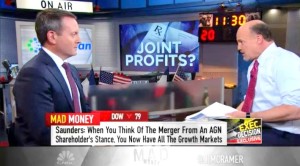
Jim Cramer interviews Allergan's CEO Brent Saunders
Last week, Jim Cramer learned that the much-discussed merger between Allergan and Pfizer is really happening. This would create the world's largest pharmaceutical deal, with $160 billion in an all stock transaction…The deal stipulated that Allergan shareholders would receive 11.3 shares of Pfizer for every one share of Allergan…"Even though I think this is a very smart deal, one that will give Pfizer a tremendous pipeline of new drugs along with a lower Irish corporate tax rate, the market initially seemed pretty skeptical,"…Allergan's stock initially sold off on the news, as investors worried what could be in it for them on the deal. However, since that time the stock has rebounded…many questions remain on how the transaction will reward Allergan shareholders, given how much the company already has going for it on its own. That is why Cramer decided to go straight to the source, and spoke with Allergan's CEO Brent Saunders.
- Exclusive: Investments give lawmakers personal stake in biotech, health care (statnews.com)
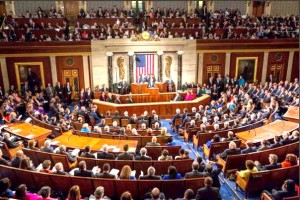
The congressman didn’t mince words when the Food and Drug Administration aired a plan to regulate diagnostic tests at a recent hearing. That could slow approvals, Representative Christopher Collins warned: “You run the risk of causing people to die.”…What Collins didn’t say at the hearing was that he has a financial stake in the issue: He co-founded a company that makes components for those tests. And he retains an ownership stake in that company, an asset he values at between $5 million and $25 million…Welcome to Congress, where such arrangements are legal — and to many critics, deeply disturbing…analysis of thousands of pages of congressional disclosure forms found that about 30 percent of senators and 20 percent of representatives held assets in biomedical and health-care companies, or in specialty funds set up to invest in those industries, during 2014…Some of the most aggressive congressional investors in the biomedical sector also sit on key committees, such as the House Judiciary Committee, which has jurisdiction over patent law, or the House Energy and Commerce Committee, which oversees the Food and Drug Administration and works on many issues of critical importance to the industry, including drug regulation, research funding, and taxes on medical devices…Members of Congress are not required to recuse themselves from voting on bills that could affect their personal finances, unless they would be the primary beneficiary of the legislation.
- For real R&D innovation, blur the lines between pharma and academia: Panel (fiercebiotech.com)

"My team has created a very innovative drug, but we're still looking for a disease to treat with it."
Collaborating with academia has been de rigueur in the pharma world for years, but it's a different game these days. Recognizing that scientists on both sides of the divide can't be distant neighbors anymore, drugmakers and academics are invading each other's personal space, even working side-by-side in the same labs. They're learning unexpected things about their counterparts. And they're coming to terms with the inherent conflict between research for curiosity's sake and research for the market…optimistic about their collaborative efforts, regardless of the challenges...innovation isn't innovation unless it's put to use--i.e., taken to market--would be anathema to many academics…we try to find the best brains and give them the freedom to pursue their curiosity,"…"Basically many leading academics don't do well in structured programs."..."Our worlds are approaching each other more and more,"…and as the results of these collaborations begin to hit the market, that will give the very idea a boost…global trends will make collaborations an even more important part of working in the pharma business: "Now, with the internet, how information flows, how this generation moves across the globe, with the knowledge-driven economy, you'll see the boundaries between institutions blur even more."
- Allergan and New York settle suit over Alzheimer’s drug switching (statnews.com)Actavis Confirms Appeals Court Ruling Requiring Continued Distribution of NAMENDA IR (finance.yahoo.com)

Allergan and New York State have settled a heated antitrust lawsuit that accused the drug maker of switching patients from an older dementia pill to a newer and more expensive version in order to avoid generic competition…Allergan agreed to pay $172,000 in litigation expenses and withdraw an appeal filed last month with the US Supreme Court…The arrangement ends a bitterly fought battle over a pharmaceutical industry practice known as forced switching or product hopping. This involves pushing consumers from one product to another. The case was closely watched because it held the potential to decide the extent to which a drug maker can force a product switch without running afoul of antitrust laws…The lawsuit triggered a debate over the sometimes controversial practice of reformulating a medicine and then obtaining a patent to extend its product life cycle. But the move by Allergan highlighted competing arguments over whether the strategy is really a ruse to create an unfair monopoly or is a legitimate use of intellectual property to protect a profitable product.
- UnitedHealth Says It Should Have Avoided Obamacare Longer (bloomberg.com)
UnitedHealth Group Inc. should have stayed out of Obamacare’s new individual markets longer, the chief executive officer of the biggest U.S. health insurer said…after announcing last month that it will take hundreds of millions of dollars in losses related to the business…While the company’s other lines of business are growing, instead of expanding into Obamacare next year, the company should have kept waiting, UnitedHealth CEO Stephen Hemsley said…“It was for us a bad decision,”…“I take accountability for sitting out the exchange market in year one so we could in theory observe, learn and see how the market experience would develop. This was a prudent going-in position. In retrospect, we should have stayed out longer.”…UnitedHealth is not alone in its Obamacare struggles. Other insurers, including competitors Anthem Inc. and Aetna Inc., have also either suffered losses in the markets or said they haven’t seen the margins they expected.