
- Teva to Buy Rimsa for About $2.3 Billion (bloomberg.com)
Teva Pharmaceutical Industries Ltd. agreed to buy Mexican drugmaker Representaciones e Investigaciones Médicas SA and some assets for $2.3 billion, furthering the Israeli company’s goal of expanding in emerging markets… offers a path into Latin America’s second-largest health-care market.
- Which Big Pharma Will Grab the Lion’s Share of the Cancer Immunotherapy Market? (fool.com)
Cancer immunotherapy is one of the hottest areas of cancer research these days, and the market looks to be worth billions. Which big pharma do we think will be the biggest winner in the space?...the fight against cancer is the growing field of immunotherapy, which aims to harness the power of a patient's own immune system…Given the huge opportunity that exists for this new class of medicine, we asked our team of Motley Fool healthcare contributors to share with us the big pharma company they think has the best chance of grabbing a big piece of this emerging market.
- Israel’s MediWound signs $112 million deal in U.S. for burn treatment (reuters.com)
Israel-based MediWound has signed a five-year, $112 million contract with the U.S. authority that handles public health medical emergencies to further develop and buy the company's drug treatment for severe burns (NexoBrid,bromelain)…Investment group Clal Biotechnology, which has a 45 percent stake in MediWound, said in a statement that the deal with the Biomedical Advanced Research and Development Authority would raise preparedness for mass-casualty incidents.
- GSK in France: ‘Oui’ to manufacturing, ‘non’ to R&D (in-pharmatechnologist.com)
GSK is selling a French R&D site (Les Ulis) as part of a global restructuring move but says it will continue growing its manufacturing presence in the country… GSK is consolidating its R&D network by concentrating its operations into two global centres – Philadelphia in the US and Stevenage in the UK – that will be supported by a number of smaller ‘satellite’ sites.
- Call for Britain to over-ride patents on Roche cancer drug (reuters.com)Request for Compulsory license on T-DM1 in the UK (letter to Health Secretary Jeremy Hunt) (cancerunion.org)
In a letter to Health Secretary Jeremy Hunt on Thursday, the Coalition for Affordable T-DM1 said the government should grant a compulsory license for patents covering Kadcyla, or T-DMI (ado-trastuzumab emtansine)…allowing other companies to supply so-called biosimilar versions…As well as being rejected by NICE, from next month Kadcyla will also not be covered by the Cancer Drugs Fund…prompting Roche Chief Executive…to call Britain's drug system "stupid"…Issuing a compulsory license would put Britain on a collision course with the pharmaceuticals industry, something the government is unlikely to want given its desire to encourage life sciences.
- Drug industry must address image problem over prices: Teva executive (reuters.com)

Teva Pharmaceutical Industries Ltd's research chief said...the drug industry must act responsibly when it comes to pricing medications, given the mounting anger over the high cost of therapies in the United States…True innovation needs to be rewarded, he said, citing strides against HIV, recent cures for hepatitis C, and those working to develop effective treatments for Alzheimer's disease…"But we need to be responsible too. Our goal is not to make money and disrupt the whole healthcare system,"…
- The drug price conundrum: a Q&A with Memorial Sloan Kettering’s Dr. Peter B. Bach (fortune.com)
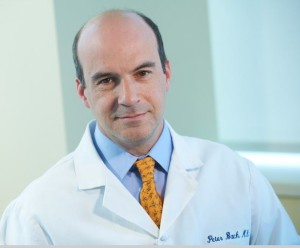
Drug prices: where the free market and public interest collide...Dr. Peter B. Bach, director of the Center for Health Policy and Outcomes at Memorial Sloan Kettering Cancer Center, has become an articulate advocate for creating a stronger connection between the costs of drugs and the value they deliver to patients. Fortune recently sat down with Dr. Bach to talk more about what is behind the drug price mayhem and what could be done to stem the rise.
- What have been the primary forces driving drug prices higher?
- So do you see these factors reversing or slowing at any point?
- What is the difference, then, when it comes to drug pricing and what’s happening with Turing versus the broader market of new, innovative drugs?
- Why is there a seeming lack of transparency when it comes to how companies decide on these drug prices?
- Do you see the role of government heading in that direction?
- PrescribeWellness Launches StarWellness+ (finance.yahoo.com)

Pharmacies can more easily manage their patients on medication synchronization...PrescribeWellness …launched StarWellness+, an add-on service to PrescribeWellness’ popular Med Sync software, StarWellness…empowers pharmacies…to streamline their workflow for patients enrolled in medication synchronization….the pharmacist can push synced medications into the workflow queue of virtually any pharmacy management system… will help them expand their med sync offering and improve adherence with hundreds of their patients…
- WHO ramps up HIV drug push with call for early treatment for all (reuters.com)
Everyone with HIV should be given anti-retroviral drugs as soon as possible after diagnosis, meaning 37 million people worldwide should be on treatment, the World Health Organization said on Wednesday…early drug use extends the lives of those with the AIDS-causing virus and cuts the risk of disease transmission to partners…making the new recommendation a reality would require dramatically increased financial support from donors and governments… WHO estimates…low- and lower-middle income countries will need $18.4 billion annually for the expanded HIV fight.
- Lawmakers Seek Answers on Valeant’s Price Increases (wsj.com)
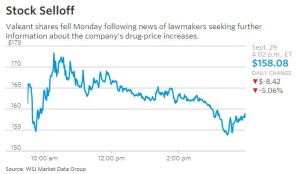
Drug maker’s stock price falls 17% after Democrats request subpoena...Democrats on the House oversight committee are trying to force Valeant Pharmaceuticals International Inc. to provide documents explaining hefty price increases for two heart drugs.( 212% Isuprel and 525% Nitropress)..Valeant shares fell 16.5% to $166.50 Monday following news of the request for a subpoena. The stock had fallen more than 12% over the previous several days amid increasing criticism from law makers about drug-price increases…"We believe it is critical to hold drug companies to account when they engage in ‘a business strategy of buying old neglected drugs and turning them into high-price ‘specialty drugs…