
- Big Pharma Payments for High Prescribing Doctors (news.yahoo.com)
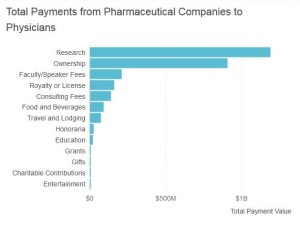
In an ideal world, doctors avoid outside influence and commit to ethical practice. However, they are also huge influencers in a for-profit pharmaceutical industry. This creates a breeding ground for potential conflicts of interest…In order to make relationships between health care providers and pharmaceutical companies more transparent, the Physician Payments Sunshine Act was enacted into law…Open Payments is the program that collects this information…Within this data, a pattern emerges: doctors who prescribe a lot of drugs tend to get more money from pharmaceutical companies…this data…identifies doctor and pharma relationships, it still does not determine causation. It only brings up certain questions: Are doctors prescribing specific drugs more because a pharmaceutical company is paying them? Or do pharma companies pay certain doctors because they prescribe a lot of their drugs? Further complicating the analysis is the knowledge that some physicians prescribe certain drugs in high volumes simply because they’re the best for their patients…While some argue that physicians should have nothing to do with drug marketing, others believe that collaboration between doctors and pharmaceutical companies is critical to improving the health and quality of life for patients. Not all doctors work simultaneously as drug prescribers and drug marketers, but those who do must strike a careful balance.
- How scientists rank drugs from most to least dangerous — and why the rankings are flawed (vox.com)

There's a very common drug-policy talking point that's meant to convey the absurdity of the war on drugs: Alcohol is more dangerous than marijuana, even though alcohol is legal and marijuana is not…Perhaps the biggest supporting evidence for this point is a 2010 study published in The Lancet that ranked alcohol as the most dangerous drug in the United Kingdom… Although drug policy experts generally don't dispute the assertion that alcohol is more dangerous than pot, the study, led by…David Nutt, is quite controversial. Experts see the rankings as deeply flawed, largely because they present the harms that come from drugs in a rather crude, one-dimensional manner. Even Nutt has acknowledged that the study is imperfect…There probably isn't a perfect way to evaluate and present all drug harms. Researchers will always need to balance making information simple and accessible for policymakers and the public with the inherent complexity of drugs and their effects. This makes the task of building scientific drug policies very challenging…The analysis may be flawed, but its simplicity and accessibility have won over many policy circles.
- How Stable Are the ACA Marketplaces? (commonwealthfund.org)
The news that UnitedHealth Group is considering leaving the new health insurance marketplaces established under the Affordable Care Act has prompted some concern about the their long-term viability...United Health Group’s possible departure is not really the issue. The insurer was a minor player in the individual market before the ACA passed, and currently covers only about 5 percent of marketplace enrollees…together with a few other developments, such as the failure of COOPs, the UnitedHealth Group announcement raised the fundamental question of whether the ACA marketplaces are enrolling sufficient numbers of people to ensure a well-balanced risk pool of healthy people and those with health problems. A pool where a majority of people have health problems could lead to higher premiums over time and destabilize marketplaces.
- Three types of marijuana to hit Uruguayan pharmacies in 2016 (reuters.com)

Uruguayan National Drug Board (JND)
Uruguayans will be able to choose from three varieties of state-sanctioned cannabis when marijuana starts being sold in pharmacies in the small South American country next year…Each variety will have different levels of...tetrahydrocannabinol and cannabidiol..."There will be three options with indications about the effects of each that point beginners toward starting with the lowest level" of THC...Uruguay became the first country to legalize the cultivation and distribution of marijuana in late 2013, aiming to wrest control of the trade from gangs while regulating and taxing its consumption…Authorities have developed traceable, genetically-distinct plants to ensure they do not leave Uruguay's borders or end up on the black market…The government estimates registered marijuana users will be able to buy the drug from pharmacies in mid-2016, when the country's two licensed producers start selling their first commercial load of about four tonnes…Authorities are also working with companies interested in exploring the possibility of exporting medical marijuana to the United States and Europe...
- 5 things to know about CMS’ mandatory bundled payment program (healthcareitnews.com)

CMS announced the first mandatory test of shared-risk, outcomes-based payment model and the first initiative to make hospitals financially-responsible for patient recovery, 90-days after a knee or hip replacement surgery…The landmark program, Comprehensive Care for Joint Replacement, goes into effect April 1, 2016. Patient engagement and care coordination technology will be key to helping hospitals meet cost containment requirements…can lead to lower costs and increased healthcare quality…Healthcare institutions and leaders should know five items to move forward into the coordinated care initiative:
- 789 hospitals will be impacted
- 500,000 patients can participate, annually
- Quality matters. Hospitals must adhere to strict quality metrics and keep down care costs from admissions to 90 days after discharge
- Hospitals can donate $1,000 per Medicare beneficiary for patient engagement IT and services
- CMS will provide incentives for Patient Reported Outcomes
- ADHD drugs may be a prescription for bullying (reuters.com)
Kids and teens who take prescription medicines to treat attention-deficit hyperactivity disorder may be twice as likely to be bullied as their peers who don’t have this mental health problem… Adolescents who sold their prescribed drugs to other kids – who might want the stimulants for study or diet aids – had more than four times greater odds of being bullied than their peers without ADHD…Our findings show that there is some connection between a prescription for stimulant medications and bullying, even after accounting for the fact that adolescents with ADHD may have difficulties with peers or may have other problem behaviors associated with victimization…
- Pharmacy Schools Could Use Business Courses (pharmacytimes.com)
You received a good education in pharmacy school. You studied chemistry, biology, pharmacology—the whole nine yards…This was good enough to help you pass your pharmacy boards, even get you a job. But now, you want to reboot your pharmacy, perhaps even create a dream pharmacy…How well did your pharmacy education prepare you for that?...You want to open your own pharmacy, but you don’t have the business education to determine which choices are right and which ones are not…what did they teach you about entrepreneurship and leadership, strategies and marketing, or even the necessary elements of a profit and loss statement and other financial reports?...However, pharmacy schools need to keep up with the demands of the marketplace…Entrepreneurship and leadership can be taught. So can strategies, team building, and marketing…When they’re not taught, the learning process is usually from the “school of hard knocks,” which is often far too expensive, and sometimes can be drastically misleading…
- Martin Shkreli just reminded us why we need Martin Shkreli (vox.com)Martin Shkreli, the Bad Boy of Pharmaceuticals, Hits Back (nytimes.com)

Martin Shkreli, CEO ,Turing Pharmaceuticals
Martin Shkreli thinks he made a mistake: He didn't hike the price of his drug enough…And that willingness to say something so awful, so off-putting, is just one reason why he's so darn useful to have around…Shkreli styles himself as a truth teller, saying the hard things that no one else is brave enough to reveal about health care. And in some ways, he's right! Major insurers, drugmakers, and hospital systems collect billions of dollars in annual earnings…but cloak many profit-driven decisions by defending them as beneficial for patients. By being brutally honest about his motives, Shkreli is a rare exception. His comments may be odious, but they're not baseless…That doesn't make them morally right, though. One reason we need Martin Shkreli is to protect against other Martin Shkrelis, who find ways to exploit the system and turn patients into profit centers.
- Could Big Pharma Deals Cost the U.S. Jobs? (bloomberg.com)
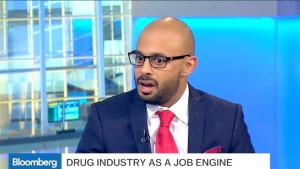
Stanford University Hoover Institution's Tim Kane, Princeton Economics Professor Alan Krueger and Bloomberg Intelligence's Asthika Goonewardene discuss pharmaceutical company deals and the possible impact on U.S. jobs.
- Crafting Your CV: A Pharmacy Residency Program’s Perspective (pharmacytimes.com)
Regardless of whether you decide to pursue postgraduate training, you will be required to submit curriculum vitae at some point during your pharmacy career…Free CV templates are available online and in software packages, but what’s missing from a lot of these templates is advice on what to fill in those little boxes…Serving on a residency advisory committee, I see hundreds of residency application annually, and certain CVs stand out from the rest. I practice in an urban teaching hospital, so the advice and comments I give will mostly pertain to the traditional institutional clinical residency…All applications for PGY-1 programs accredited by the American Society for Health-System Pharmacists are processed through the Pharmacy Online Residency Centralized Application Service system. PhORCAS is an electronic-based tool that conforms and limits what applicants can send to programs… The 2 most important components are the applicant’s CV and letter of intent. This article will focus on how you can wow the programs with your “life story.”
- Education
- Licensure
- Employment
- Training/Professional Experience
- Projects/Presentations
- Honors and Awards/Leadership
- Miscellaneous/Additional Skills
- Other Notes
Each program and each preceptor will place preference on different aspects of your CV. For me, the top 2 things I look for on an applicant’s CV are:
1. Research projects or presentations.
2. Teaching, tutoring, or lecturing experience.
3. Pharmacy work experience.Good luck to all candidates!