
- ICD-10 to get 5,500 new codes, including ones for face, hand transplants, CMS says (healthcareitnews.com)
CMS said it plans to add about 1,900 diagnosis codes and 3,651 hospital inpatient procedure codes to the coding system…On Oct. 1, the Centers for Medicare and Medicaid Services will add another 5,500 codes to the ICD-10 diagnostic library, officials announced…The addition will come exactly one year after ICD-10, with its nearly 70,000 billable codes, replaced the dated, and much more compact, ICD-9 code set… The new and revised ICD-10-CM (Clinical Modification) and ICD-10 PCS (Procedure Coding System) codes will be included in the hospital inpatient prospective payment system proposed rule for fiscal 2017…
- 3 Legislative and Regulatory Updates Pertinent to Pharmacists (pharmacytimes.com)
...at APhA’s 2016 Annual Meeting & Exposition...they discussed...the proposed nondiscrimination rule, pending pharmacist provider status legislation, and draft guidance on prescription drug abuse...
- Proposed Nondiscrimination Rule - Under this proposed rule, pharmacies would be required to offer language assistance services to patients with limited English, unless the pharmacy would face "undue financial burden," or if doing so would "result in a fundamental alternation in an entity’s health program or entity,"...also applies to the requirement that pharmacies provide auxiliary aids and services and the accessibility of programs through electronic and information technology...HHS does not expect compliance with the proposed rule to cost too much, and training employees on these new requirements is voluntary.
- Pharmacist Provider Status Legislation - legislation would allow pharmacists to be reimbursed for their services as long as the pharmacist serves in medically underserved areas, health professional shortage areas, or for medically underserved populations and follows the state’s scope of practice laws...there has been no opposition to the proposed legislation...cost will be a challenge...The next steps are getting a Congressional Budget Office score, meaning a cost estimate for the bill...they hope to see a score within a few weeks, and then a few weeks later, they can expect a House hearing.
- Draft Guidance on Prescription Drug Abuse - the Centers for Disease Control and Prevention issued draft guidance for prescribing opioids for chronic pain, which were fairly controversial...APhA’s comments on the guidelines included the fact that a team-based approach to care including pharmacists was needed. In addition, the guidelines should mention that the lowest-effective dose should be patient-specific, and more education is needed for health care professionals.
- PillDrill named ‘Best New Product’ at ECRM’s Home Health Care EPPS event (drugstorenews.com)

PillDrill won this year’s Drug Store News/ECRM Most Innovative Product Award...PillDrill was developed to be a smart, friendly medication tracking system that simplifies the task of everyday pill taking. It gives reminders when pills need to be taken, tracks what’s being taken with a quick scan and sends real-time adherence updates to those people involved in the patients' well-being...We learned early on that medication adherence is not a technology problem, it’s a human problem...So what makes PillDrill special is that it’s completely user-centric. It’s not some complicated piece of hardware, and it’s not an app; those things don’t really work for people in their everyday context…PillDrill is a light overlay onto an existing routine that provides all the benefits of a technology product without any of the hassles.
- Pharmacy Week in Review: March 11, 2016 (pharmacytimes.com)
Mike Glaicar, Business Development: Pharmacy Times...(PTNN) This weekly video program provides our readers with an in-depth review of the latest news, product approvals, FDA rulings and more.
- When It Comes To Health, Rural Areas Getting Left Behind (forbes.com)2016 County Health Rankings - Nevada (countyhealthrankings.org)Washoe County ranks fifth in Nevada health rankings (kolotv.com)Report ranks Clark County sixth in Nevada for health outcomes (reviewjournal.com)
...the Robert Wood Johnson Foundation released its seventh annual County Health Rankings, which, despite their name, aren’t a competition between U.S. counties to see who’s the best at health. Rather, the report exists to assess all the counties in the U.S. based on factors ranging from tobacco use and access to healthcare to air quality and even education…on the whole and for most of the country, the report doesn’t look terrible. Generally speaking, premature death numbers–a key indicator of overall community health–have been steadily going down. That is, unless you live in a rural area...There are 46 million people who live in rural communities. Nearly one in six Americans lives in a rural area…And the challenges they are facing are showing up in how they are not living as long as other Americans… Many of those rural counties, in fact, are already finding ways to address their local problems by offering services that are otherwise out of reach…some rural areas are getting together with communities nearby and combining to offer services that would be impossible to do alone…
- Drug spending increase slowed to 5.2 percent last year, Express Scripts says (statnews.com)

Despite rising prices for prescription medicines, Express Scripts released data today showing spending for its health plans rose 5.2 percent in 2015, roughly half of what was seen the year before...the average price of brand-name drugs rose 16.2 percent in 2015...Most of the increased spending was for specialty medications — such as those for hepatitis C, cancer, and other hard-to-treat diseases. Spending for these drugs rose nearly 18 percent, compared with a 0.1 percent drop for traditional drugs for chronic conditions...usage rose nearly 7 percent for specialty medicines, compared with 2 percent for other drugs...Express Scripts boasted that it has successfully used various techniques to manage drug costs. These include formularies with various so-called tiers, which are lists of preferred drugs that require consumers to pay varying amounts. Another tactic is prior authorization, which involves requiring consumers to try different treatments before a more expensive medicine...Another move...was...to curtail coverage of many compounded medications...Total spending on compounded treatments for pain and skin conditions fell 54 percent as usage dropped 56 percent.
- FlavoRx unveils new FlavorMaster (drugstorenews.com)

FlavoRx debuted its newest piece of pharmacy equipment — the FlavorMaster — the reconstituting and flavoring device...The FlavorMaster uses FlavoRx’s Fillmaster water dispensing technology and its flavors, making reconstitution available with the press of a button...pharmacies have the power to boost pediatric adherence and improve a child’s health outcome...
- Rattled by drug price increases, hospitals seek ways to stay on guard (washingtonpost.com)

Doctors at the University Hospitals of Cleveland see an immediately recognizable symbol pop up alongside certain drugs when they sign in online these days to prescribe medications for patients: $$$$$...The dollar signs, affixed by hospital administrators, carry a not-so-subtle message: Think twice before using this drug. Pick an alternative if possible...The Zagat-like approach is just one of the strategies hospitals nationwide are using to try to counter drug costs. It was inspired...by... the University Hospitals system’s vice president of pharmacy services, who saw unexpected price hikes wreak havoc on his budget last year...The industry...notes that drug spending accounts for only about 10 percent of the country’s health-care costs and that published list prices do not reflect the steep discounts and rebates that companies may offer. Hospitals generally purchase drugs from wholesalers at costs below the list price, although wholesale prices are subject to increases...Hospital officials insist that even when sudden price increases occur, patients receive access to the medicines they need. But the unpredictable increases wedge their institutions financially...They can’t immediately pass on the cost if a drug gets more expensive because reimbursement rates for certain procedures already have been set by Medicare and private insurers. That means sharply higher prices can lead to losses..."I want drug companies to make money. I need them to make money, or I don’t have any ammo..."But there has to be a balance, a middle ground. If this keeps happening . . . it’s only a matter of time before we get to a point where we have to choose less desirable medications than what’s out there."
- The End of Prescriptions as We Know Them in New York (nytimes.com)

Starting on March 27, the way prescriptions are written in New York State will change. Gone will be doctors’ prescription pads and famously bad handwriting. In their place: pointing and clicking, as prescriptions are created electronically and zapped straight to pharmacies in all but the most exceptional circumstances...New York is the first state to require that all prescriptions be created electronically and to back up that mandate with penalties, including fines and imprisonment, for physicians who fail to comply. Minnesota has a law requiring electronic prescribing but does not penalize doctors who cling to pen and paper...Just as doctors putting away their pads will face a culture change in New York, so, too, will patients, who will no longer be able to shop around for the shortest waiting time or the best price for their medications...“It’s probably driven us to prescribe more standardized regimens and more standardized dosing,” said Dr. Paul A. Testa, the chief medical information officer at NYU Langone. “And the reality is, there is always the phone. If I have a doubt, I can call the pharmacy.”
- APhA releases 2016 edition of the APhA Pharmacists’ Patient Care Services Digest (drugstorenews.com)Pharmacist's Patient Care Services Digest (media.pharmacist.com)
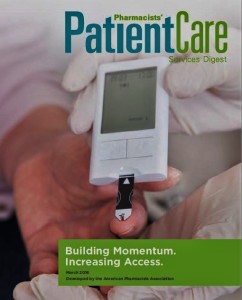
The American Pharmacists Association...released the 2016 edition of the APhA Pharmacists’ Patient Care Services Digest. The publication shows the continued growth of pharmacists’ patient care services and highlights the expanded roles pharmacists have in the health care system... Overall, findings from the survey indicate that there is a continued expansion of pharmacist-provided patient care; confidence in pharmacists as care providers continues to grow; pharmacists are reducing gaps in care and improving performance for health plans; and work systems and processes are being aligned with desired outcomes of care...