
- Sanofi whistleblower lawsuit kicks into higher gear (cnbc.com)
A whistleblowing former paralegal at drug giant Sanofi is now claiming she was aware of "many instances" where Sanofi lawyers destroyed documents to avoid turning them over to opponents in prior legal cases…Ex-Sanofi paralegal Diane Ponte's new allegation comes in an affidavit she filed in her pending lawsuit against the company...claims she learned of an alleged scheme at Sanofi to pay more than $30 million in kickbacks to promote the company's diabetes drugs. The suit came a year after the France-based drug company already agreed to pay more than $100 million to the U.S. federal government to settle other claims related to alleged kickbacks to doctors, and seven months after Sanofi agreed to pay a nearly $40 million fine in Germany in connection with two employees who were convicted there of paying bribes to boost drug sales.
- Treasury steps up attack on corporate tax inversions (usatoday.com)
Obama administration stepped up its attack on corporate tax inversions…announcing new rules designed to block U.S. firms from trying to cut their tax bills by reincorporating overseas…Treasury Secretary Jacob Lew, whose agency imposed initial rules restricting inversions last year, said tougher restrictions were needed because U.S. firms "are taking advantage of an environment that allows them to move their tax residence overseas in order to avoid paying taxes in the United States without making significant changes in the nature of their overall business operations."..The new restrictions will:
- Limit the ability of U.S. companies to combine with foreign firms when the new overseas parent is a tax resident of a third country.
- Restrict U.S. firms from inflating the size of the new foreign corporate parent, and thereby avoid the current rule that requires the former owners of the U.S. firm to own less than 80% of the newly combined entity.
- Strengthen the current law that enables U.S. companies to complete inversions if, after the transaction, at least 25% of the combined new entity's business activity occurs in the country where that company has tax residency. The change would block inversions unless the new foreign parent is a tax resident of the overseas country where it was created or organized.
The three changes apply to inversion deals closed Thursday and in the future.
- Here’s How Much TV Networks Would Miss All Those Viagra Ads (thestreet.com)

Sick of watching those scary, sad drug ads during the the game? So is the American Medical Association…The AMA's declaration that it would seek curbs on the ability of pharmaceutical companies to market prescription drugs… The Tuesday vote by the AMA, one of the world's largest medical trade groups, to lobby Congress as well as the Food and Drug Administration could all but eliminate a key source of ad revenue for network TV companies, including 21st Century Fox , CBS and Disney, already pressured by the success of streaming services led by Netflix, Amazon Prime and Alphabet's YouTube…It could also force changes to the fundamental marketing model of Big Pharma, which commands its own immense lobby. While pharmaceutical companies have lines of lobbyists to call on, so does the American Medical Association…"It's a large and powerful group,"…"A change like this would be a long process…and there would be freedom of speech issues, but it could certainly have an impact down the road."…Direct-to-consumer ads for drugs -- which are illegal in most Western countries -- are extremely popular in the U.S. Advertising dollars spent by pharmaceutical companies have increased 30% since 2013 to $4.5 billion domestically...
- Bumper haul of expensive new drugs heads to U.S. and Europe (reuters.com)
Food and Drug Administration has so far approved 37 novel drugs in 2015, more than the 34 that had been cleared by this stage a year ago and just short of 2014's final total of 41…European Medicines Agency is also waving through more products, recommending a total of 84 new medicines so far, up from 75 in the first 11 months of 2014…The brisk pace of new arrivals over the past two years reflects improved productivity in drug research labs and a change of pace by regulators, who have committed to speed up the process of getting life-saving treatments to patients, especially in cancer…The science has got better and we seem to be finding more molecules that are showing material improvements…the rapid pace of new drug launches is forecast to continue, with 225 new drugs expected to be approved between 2016 and 2020…Drug companies argue they need to make decent profits to pay for the billions of dollars needed for drug research. Many companies also have extensive low-cost or even free access schemes for patients who cannot afford their medicines… For healthcare systems in the developed world, paying for such pricey medicines is a challenge - but for many patients in poor countries they will remain out of reach, reflecting the economic realities of drug development.
- A Head Fake From the Taxman (bloomberg.com)
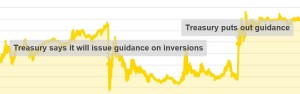
Allergan shareholders got all riled up for nothing…Shares of the Botox maker sank 2.8 percent on Thursday as fears that the U.S. Treasury Department was about to get tougher on inversions outweighed the news that Pfizer was preparing a nearly $200 billion bid for the company. The department's new guidelines -- announced after the market close -- turned out not to be such a body blow after all…the proposed changes just fine tune the steps already taken by the Treasury last year to make it harder and less appealing for companies to use acquisitions that move their legal address abroad for tax benefits. There was nothing groundbreaking -- and most importantly, nothing that should significantly derail a Pfizer inversion…Cue Allergan shares making up their losses and then some on Friday…The latest guidelines do make it incrementally harder to structure inversions and remove some economic benefits, but the handicaps only apply to transactions in which the U.S. company's investors wind up with between 60 percent and 80 percent of the combined entity. Pfizer already knew that was dangerous territory; those were the types of inversions targeted by the Treasury last year. By structuring its Allergan purchase as an all-stock deal with a high premium, Pfizer could be able to skirt the tougher rules.
- Pfizer-Allergan talks accelerate amid new inversion clamp-down (reuters.com)
Pfizer Inc's talks to acquire Allergan Plc in a $150 billion deal that would see the U.S. drug giant redomicile in Ireland accelerated… as the U.S. Treasury prepared to clamp down further on such tax inversions… While negotiations have made progress in recent days, an agreement is not imminent and its timing remains uncertain following the Treasury's disclosure that it would seek to tighten the rules on inversions…Inversions typically involve a U.S. multinational buying a smaller foreign competitor and relocating to its home country, if only on paper, to escape U.S. taxation. Ireland is a common destination. Management usually stays in the United States…
- The company wants to double its workforce and sales on the continent by 2020 (fiercepharma.com)

Merck KGaA has been turning to emerging markets to deliver a much-needed boost to business, targeting China and Latin America as areas ripe for growth. Now the German pharma is turning its sails toward Africa, planning to expand its presence on the continent over the next 5 years…Merck KGaA wants to double its workforce and sales in Africa by 2020, drawing on the region's "entrepreneurial spirit and innovation power" to drive growth…the company…has about 400 employees in 10 African countries and will increase this number to about 1,000. The drugmaker's sales on the continent will climb to €500 million ($534 million) by 2020 from €200 million in 2015…
- Pfizer and Allergan to approve $150B merger (cnbc.com)
Pfizer was due to secure formal board approval on Sunday for its acquisition of Botox maker Allergan for more than $150 billion, making it the healthcare sector's largest deal ever...The deal would involve Pfizer paying with 11.3 of its shares for each Allergan share...There will also be a small cash component, accounting for less than 10 percent of the value of the deal...Pfizer's Chief Executive Ian Read…will be CEO of the combined company, with Allergan's CEO Brent Saunders…serving in a very senior role focused on operations and the integration…It would be the biggest merger of the year, topping beer maker Anheuser-Busch InBev's proposed $107 billion takeover of SABMiller Plc. And it would realize Read's longtime ambition of an "inversion" deal that would get Pfizer out from under the 35 percent U.S. corporate tax rate, among the world's highest. The tax rate in Ireland is 12.5 percent…U.S. Treasury last year, and again last week, updated its rules on inversions to make it harder for companies to avoid U.S taxes by moving overseas. But experts have said these moves would do little to prevent Pfizer from inverting.
- After the Valeant-Philidor Blowup, PBMs Clamp Down on Network Pharmacies (drugchannels.net)

The initial fallout from the Valeant-Philidor kerfuffle has hit the pharmacy industry. Over the past few weeks, the major pharmacy benefit managers have begun dropping pharmacies from their networks. Some PBMs are also reminding retail pharmacies that they are prohibited from acting as mail pharmacies…I highlight the high-profile network pruning by the top three PBMs—Express Scripts, the Caremark PBM business of CVS Health, and the OptumRx business of UnitedHealthcare. I also speculate on the factors that would lead a PBM to clash with a pharmacy in its network…An as-yet-unanswered question: If PBMs routinely monitor their networks, why did it take a highly publicized pharmacy meltdown before PBMs finally cracked down?
- Antibiotics: urgent calls for global payment pot (in-pharmatechnologist.com)Securing New Drugs for Future Generations: The Pipeline of Antibiotics the Review on Antimicrobial Resistance (amr-review.org)
As World Antibiotics Awareness Week draws attention to the threat of resistance, pharma companies large and small say a worldwide overhaul of payment models will make anti-infective R&D profitable again…AstraZeneca published an open letter…calling on the UK government to attract companies to antibiotics discovery work with a more profitable funding mechanism…the pharma industry has been reluctant to sink funds into what it perceives as a poor return on investment. Traditional payment models – where companies profit per volume sold – are a weak incentive in an area where prescription levels are deliberately limited to prevent resistance…Documents so far suggest a shared pot funded by countries – possibly the G20 – “to establish a mechanism to purchase the global sales rights to new antibiotics, and to subsequently manage their supply internationally.“The development and manufacture of drugs would still take place within the pharmaceutical industry, drawn through the pipeline by the incentive of a full ‘buyout’ of their product once it is ready to market. Although the developer would surrender the right to market their new drug, they would be reimbursed by an amount sufficient to ensure an adequate return on their development costs, and the investment incurred.”